

Ten desktop brackets · A labelled variant set
Ten desktop brackets: one revision or a mixed set?
Hypothetical design study
This is an original fictional brief for ten non-critical brackets to support small paper display cards on an indoor desk. The quantity and use are assumptions for the example. The concepts have not been manufactured, measured or approved for use.

Ten fictional desk brackets illustrate a request for ten copies of one selected revision. The view does not demonstrate manufactured consistency, an actual order or an approved material.
One named revision
The illustration represents the single-revision option. Put the exact export name beside its quantity.
Visible-face priority
For a real bracket, mark the face that matters visually and explain how it will be used.
The decision
The designer has two revisions. Rev A has a shorter slot; Rev B has a longer slot intended to explore more adjustment. The circular reference feature is intended to stay in the same place. The brief must identify whether the request is ten copies of one chosen version or a deliberate comparison containing both.

Rev A has the shorter slot; Rev B has the longer slot. The circular reference feature is intended to remain unchanged. This is a visual concept, not a dimensioned drawing or measured part.
Changed slot
Rev A: short slot. Rev B: longer slot. The actual slot dimensions would need to be specified.
Unchanged reference feature
The circular hole is the intended reference in both versions; its exact size and position would need to be defined in CAD.
Approach 1 — ten copies of one confirmed model
One option would be to settle the design first and request ten copies of desk-bracket-rB.stl. The row has one revision and one quantity. This could simplify identification and keep the request focused on the selected shape, provided the intended dimensions, attachment and use have been established.
The trade-off is that the batch would no longer explore the short-slot alternative. A visually appealing render would not establish that the longer slot provides the required adjustment or leaves enough material around it.
Approach 2 — an intentional comparison of two revisions
Another option would be five Rev A and five Rev B, with both lines explicitly requested for a comparison. This could help organise a physical assessment of the proposed difference. It would require a defined assessment question and a way to keep the versions identifiable. It would not produce ten identical parts.
This option begins by resolving the contents of the request. Sending two near-identical files labelled “final” with a single quantity of ten leaves the intended mix unresolved.
| Example request | Rev A | Rev B | Meaning |
|---|---|---|---|
| One selected revision | 0 | 10 | Ten copies of Rev B |
| Deliberate comparison | 5 | 5 | Ten pieces across two specified revisions |
| Two files, only “quantity 10” | Unstated | Unstated | Clarify the split before ordering |
Technical considerations
If the concept were developed in FDM, orientation could affect both appearance and mechanical behaviour. The brief would need to explain how the part is supported and used, alongside the visible-face priority. Prusa: modelling for 3D printing. No material, print orientation or load capacity is selected by this illustration.
Confirm before manufacture
- Overall dimensions and units, slot width/length and the reference-hole position.
- The card, attachment method and actual contact geometry; any movement required.
- Material grade, operating conditions, handling and loads, even for this non-critical use.
- The visible face, acceptable finish and any dimensional/functional checks needed.
- Which revision or revisions are required, quantities for each, and the intended assessment before later use.
Send for a quote
Provide the intended model files and a line-by-line revision/quantity list, plus dimensions, use, visible-face notes and required date. Use Get an Instant Quote for a supported print-ready model. If the revision or mixed-set requirement needs discussion, contact us before ordering; if the slot needs changing, begin with CAD design.
Use the small-batch brief guide
A labelled variant set: three configurations, six pieces
Hypothetical design study
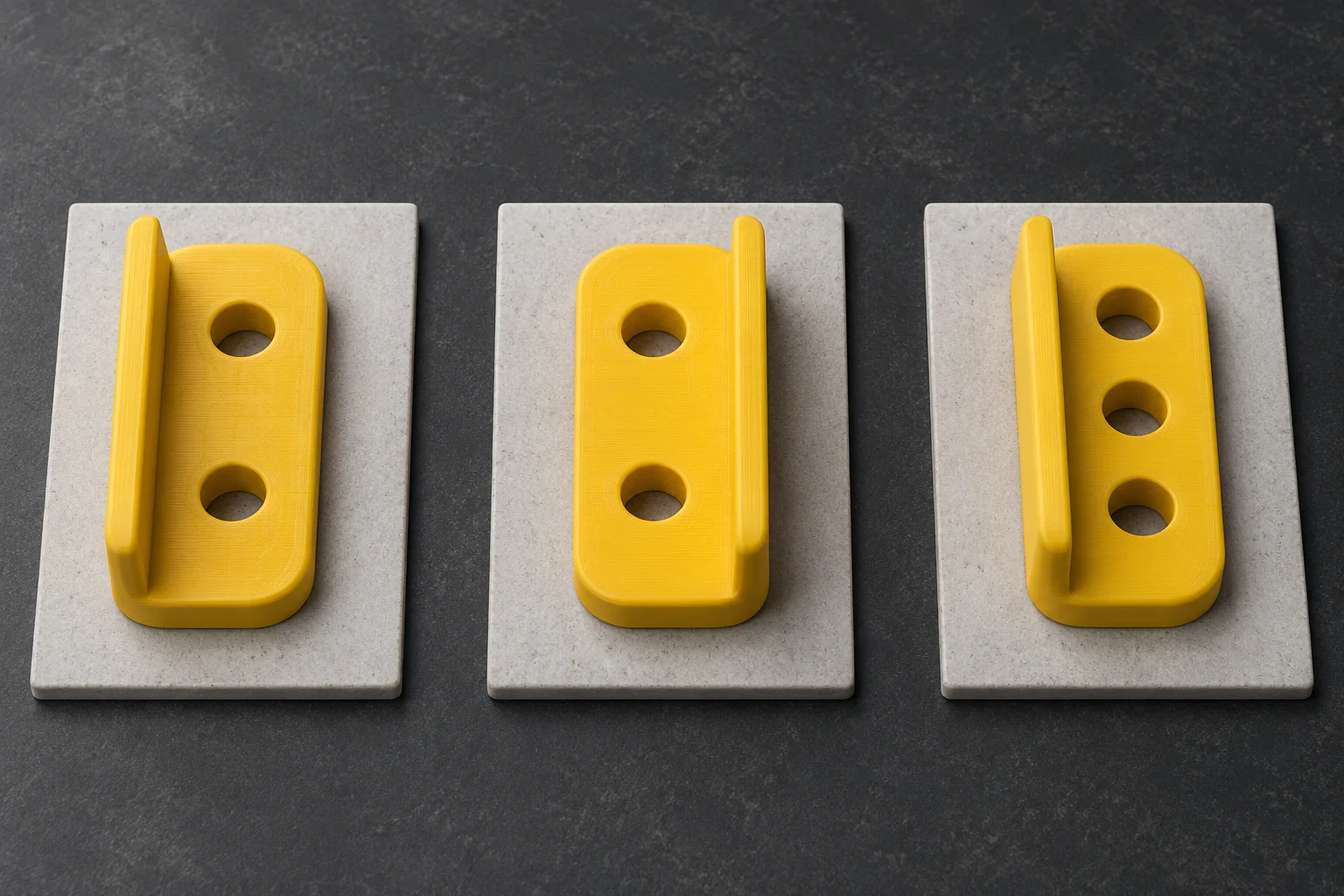
This independently invented example concerns small desktop cable-guide feet for a light-duty indoor organisation concept. Assume three configurations: a left-side guide with two holes, its right-side counterpart and a left-side guide with a three-hole pattern. The shapes, quantities and intended use are fictional; they are not a completed order or qualified cable-retention design.

One concept of each configuration is shown: A has a left-side fin and two holes; B has a right-side fin and two holes; C has a left-side fin and three holes. Quantities belong in the accompanying table. No customer project or manufactured set is depicted.
DGF-L-2H
Left fin · two holes · r01 · example quantity 3
DGF-R-2H
Right fin · two holes · r01 · example quantity 2
DGF-L-3H
Left fin · three holes · r01 · example quantity 1
Define the viewing direction first.
Here, “left” and “right” refer to the displayed top view, with the long edge of each foot vertical. The guide fin’s side and the hole pattern identify the configuration. A print request would need the actual reference view and dimensions, rather than relying on a perspective image alone.
| View label | Part / variant ID | Revision | Illustrative file name | Finished pieces |
|---|---|---|---|---|
| A | DGF-L-2H | r01 | DGF-L-2H-r01.stl |
3 |
| B | DGF-R-2H | r01 | DGF-R-2H-r01.stl |
2 |
| C | DGF-L-3H | r01 | DGF-L-3H-r01.stl |
1 |
| Total | Three configurations | — | Three distinct model exports | 6 |
The illustration shows one concept of each configuration so the differences can be read. The order-specimen quantities are in the table. These filenames are examples, not downloadable CAD.
Approach 1 — three separate item lines
One option would be to request A, B and C as separately named items with quantities three, two and one. This could suit a request where the variants are tracked individually or reordered in different quantities. It keeps each geometry and its revision directly connected to a piece count.
The trade-off is that a total quantity alone cannot describe the intended mix. A later reorder would still need the three quantities and the applicable revisions.
Approach 2 — one explicitly defined kit
Another option would be to describe one kit containing three A, two B and one C. This could help when the same combination is needed together. Keep the underlying item list and revisions, then state the kit quantity separately: one kit here means six finished pieces.
The trade-off is the extra definition of what a kit contains. “One set” without that list would be ambiguous. Kit wording is an organisational description; it does not establish a bundle price, packaging service or automatic quantity handling in the quote form. Keep the three model identities clear rather than assuming a multi-object file is interpreted as one finished piece.
Geometry and surface questions
The left/right pair would need a defined mirror relationship, while the three-hole variant would need its own hole positions. Clearance depends on the actual geometry, material and printing conditions; a universal fit allowance is not assumed. Prusa: tolerances.
The pale pads and yellow colour help separate the concepts visually. They do not specify a mounting substrate, material grade or stock colour. If a physical part identifier is wanted, its geometry, location and legibility would need to be included in the CAD request.
Confirm before manufacture
- The exact handedness convention, matching reference view and dimensions of each configuration.
- Hole positions, diameters, mating hardware and attachment/clearance requirements.
- Cable dimensions and intended handling; whether the concept needs redesign for the real use.
- Material grade, environment, visible faces and any required checks before use.
- Quantities per item, kit contents if relevant, and the revision of every model.
Send for a quote
Provide one clearly identified model per configuration, its revision and required quantity, plus the marked view and intended use. Begin with Get an Instant Quote for supported models. Check the model preview, quantity and available options in the form. For a mixed set or kit the form does not clearly express, contact us before ordering. Use CAD design if the left/right or hole-pattern models still need creating.